|
| |||||||
|
|||||||
|
| |||||||
| SAILING Sailing These parameters determine how your ship sails. Max Speed: Maximum Speed SHIPHow fast your ship can move in battles. Improving battle speed does not improve Open Sea speed. Acceleration: Acceleration Determines how fast the ship gains speed. Deceleration: Deceleration Determines how fast the ship loses speed. Lower values are better if you want to maintain speed, higher values are better if you want to stop quickly. Turning (Fast): Fast Turn Rate The Ship's turn rate in degrees per second. This is how fast the ship turns if it is moving at maximum speed. Turning (Slow): Slow Turn Rate The Ship's turn rate in degrees per second. This is how fast the ship turns if it is moving at a speed of at least 4 knots. Turning Accel: Max Turning Acceleration This shows how fast a ship accelerates into a turn. The higher the value, the faster the ship reaches its maximum turn rate. Turning Decel: Min Turning Deceleration Ships gradually suffer less deceleration as they turn. This shows a minimum amount of deceleration a ship has when turning. Lower numbers (relative to other acceleration stats) are better. Best Point: Best Point The wind angle at which the ship can attain its maximum speed. The wind comes from angle 0o, and angle 180o is running with the wind at your back. Capacity: Capacity How many units of cargo the ship can hold. O.S. Visibility: Open Sea Visibility How far away other ships will spot you on the open sea. O.S. Spotting: Open Sea Spotting Increases your spotting range, allowing you to detect ships beyond their O.S. Visibility. Crew: Crew The maximum number of crew on your ship. Shows the fighting strength of your crew. Target Tracking: Target Tracking Reduces the accuracy penalties you suffer due to your movement and your target's movement. Improves your chance to hit fast moving ships. |
21.45 3.64 5.00 14.10 8.35 10.57 11.70 90 180 42.9 0.0 56 26 |
4 ( Small) LEVEL (SIZE): Level and Size6 1173 The level required to use this ship, and the size of the hull. DURABILITY: Durability The number of ships you have left. Decreases by 1 whenever the ship is defeated in combat (with the exception of skirmish). INSURANCE VALUE: Insurance Value Amount of doubloons you will receive for this ship if she is sunk or scuttled. |
|||||||||||||||||||||||||||
| HEALTH Health The ship's Health stats show how much damage it can sustain. Hull: Hull (Structure) The internal structure of your ship. When your structure runs out, your ship sinks. Port: Port (Left) The ship's port armor. Armor facings protect the ship's hull. Stbd: Starboard (Right) The ship's starboard armor. Armor facings protect the ship's hull. Bow: Bow (Front) The ship's bow armor. Armor facings protect the ship's hull. Stern: Stern (Rear) The ship's stern armor. Armor facings protect the ship's hull. Sails: Sails & Masts Shows how much damage the ship's sails and masts can sustain. Ships lose speed as they take sail damage. |
Integ. Integrity The ship's Integrity stats show how much damage it can sustain. 630 425 425 210 100 840 |
DR Damage Reduction Shows how much the ship's armor reduces the damage it receives. - 3 3 2 1 0 |
|||||||||||||||||||||||||||
| MODIFIERS Modifiers These change your chance to hit, chance to get hit and the damage you take. Sails: Sails Offense, defense and resistance values for your ship's sails and masts. Crew: Crew Offense, defense and resistance values for your ship's crew. Bow: Bow (Front) Offense, defense and resistance values for your ship's bow armor. Stern: Stern (Rear) Offense, defense and resistance values for your ship's stern armor. Sides: Broadsides (Left & Right) Offense, defense and resistance values for your ship's broadsides. Grapple: Grappling Grappling offense makes it easier to board ships. Grappling defense protects you against hostile boarding attempts. |
OFF Offense Offensive modifiers are a percentage increase to your chance to hit. The numbers here include any benefits from 'Accuracy, All' items. 0.0 0.0 0.0 0.0 0.0 0.0 |
DEF Defense Defensive modifiers are a percentage decrease to the chance enemies will hit you. The numbers here include any benefits from 'Defense, All' items. 43.0 43.0 43.0 43.0 43.0 0.0 |
RES Resistance Resistance is a percentage reduction in the damage you take. 0.0 0.0 0.0 0.0 0.0 - |
||||||||||||||||||||||||||
Polars
Upwind & Luffing
Close
Haul Close
Haul Beam
Reach Beam
Reach Broad
Reach Broad
Reach Running
33% - 43% 7.08 - 9.22 knots 35° 18.77 knots 87.5% 18.77 knots 87.5% 21.45 knots100% 100%21.45 knots 17.7 knots 82.5% 17.7 knots 82.5% 13.94 knots 65% Open Sea Speed: 64
|
|||||||||||||||||||||||||||||
02.10.57.00
Combat Level
Combat Level: 5
WARNING
- The correct "Polars" and "Open Sea Speed" remain unavailable at this time.
General
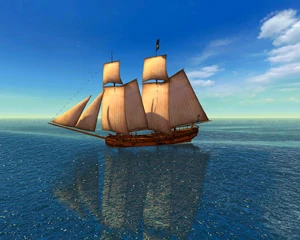
Similar to the Halifax, the larger schooner is much tougher but she has the same lack of firepower.
History
A schooner is a type of sailing vessel characterized by the use of fore-and-aft sails on two or more masts. Schooners were first used by the Dutch in the 16th or 17th century, and further developed in North America from the early 18th century onwards. According to the 1911 Encyclopedia Britannica, the first ship called a schooner was built by builder Andrew Robinson and launched in 1713 from Gloucester, Massachusetts. Legend has it that the name schooner was the result of a spectator exclaiming "Oh how she scoons", scoon being a Scots word meaning to skip or skim over the water. Robinson replied, "A schooner let her be." According to Walter William Skeat, the term schooner comes from the word scoon, while the sch spelling comes from the later adoption of the Dutch and German
Strategy and Use
A good upgrade from the 'Halifax' Schooner this is larger and better armored though at a cost in speed.
Tactics
Good for boarding smaller ships this vessel can ram and muscle them into the wind to make slow them for boarding.
Variants
Other variants of the Chaleur:
Comparable Ships
Distinguishing Characteristics
The schooner sail-plan has two or more masts with the forward mast being shorter or the same height as the rear masts. Most traditionally rigged schooners are gaff rigged, sometimes carrying a square topsail on the foremast and occasionally, in addition, a square fore-course (together with the gaff foresail). Schooners carrying square sails are called square-topsail schooners.
Sources
Wikipedia article on schooners
Version History
(2.14.21.0) 2014-03-04
- Changed cannon battery stats
- Cannon accuracy figures to be included in an upcoming hotfix patch